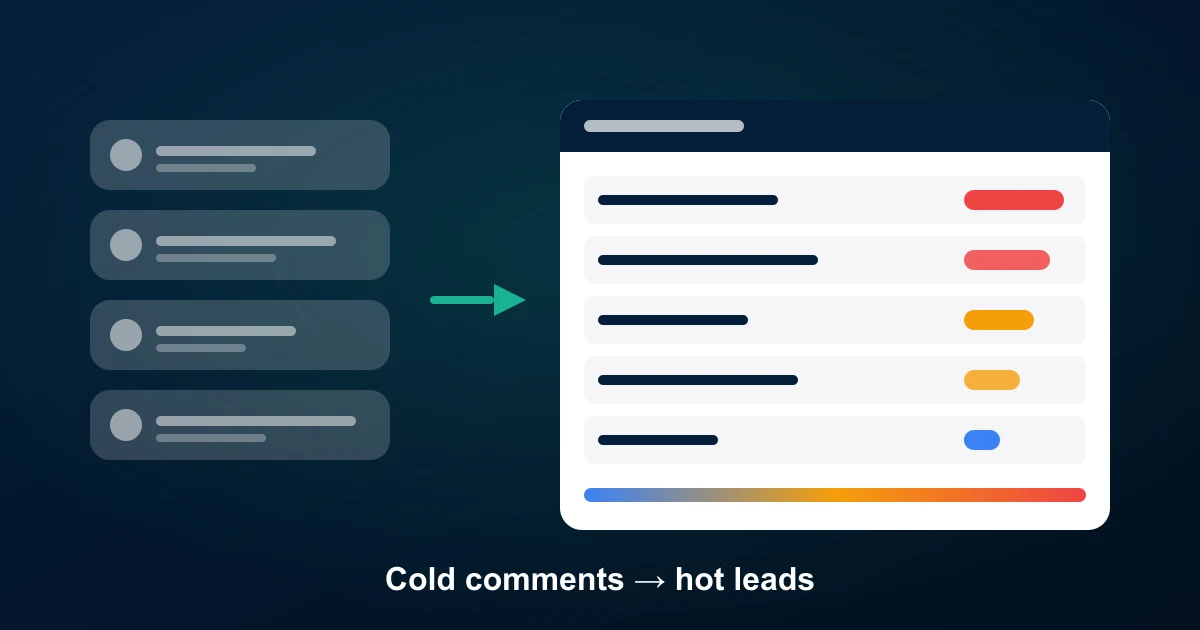
This is a use-case post, not a feature tour. One of our customers — a TikTok Shop seller of home-fitness gear, details anonymised with permission — was sending around 200 DMs a week to people who had commented on their videos and getting four or five replies. Two percent. They were treating every commenter as a lead and every lead as hot. The fix wasn't a better DM script. It was a TikTok comment export used as a scoring sheet, so that "cold" and "hot" became numbers instead of guesses. Six weeks later they were sending 60 DMs a week and getting 18 or 19 replies. Here is exactly what they do, step by step, so you can copy it.
The seller and the problem: 200 DMs, 4 replies
The account posts short demo videos — a resistance band routine, a foldable bench — and each one pulls 150 to 600 comments. The seller's original process was to open the comment section on their phone, tap through to every username that said anything vaguely positive, and send the same message: a product link and a discount code. TikTok's app only shows a curated slice of the comments, so they were also missing most of the thread entirely; they had no idea how many comments they'd never seen.
Two things were wrong at once. They were messaging people with zero intent (a "🔥" is not a lead), and they were messaging the people with real intent in exactly the same way, with a link, cold. The buyers who had asked "does this hold 120kg?" got a discount code instead of an answer, and understandably ignored it.
What "cold" and "hot" mean when the lead came from a comment
In classic lead scoring — HubSpot's version is the one most people learn — you score on fit (are they the right customer) and on behaviour (what have they done). A comment gives you almost nothing on fit, but it gives you a surprising amount on behaviour, if you can see the whole thread at once. The seller's definitions, which we've adopted when talking to other customers:
- Cold — one comment, no question, no follow-up. Attention, not intent.
- Warm — asked a question, or commented twice, or replied to another commenter, or named a use case.
- Hot — two or more warm signals, or a returning commenter (came back to the thread days later), or a direct "where do I buy" / "link?".
The crucial idea is that a lead isn't born hot. Most of the seller's eventual buyers started as one-comment cold leads and were warmed by a public reply. The export is what makes that warming systematic instead of accidental.
The scoring sheet: five columns that warm a lead before you touch it
The seller pastes the video URL into the TikTok comment exporter, downloads Excel, and adds one column: score. The file already has author, username, text, likes, replies, created_at, language, is_pinned, id and reply_to_id. Five signals, one point each, all derivable from those columns:
- A question mark or a question word in
text. "does", "how", "will it", "can I". A filter formula, thirty seconds. - The same
usernameappearing more than once. A COUNTIF on the username column. Two comments is a person who came back to look. - A non-empty
reply_to_id. They replied to someone else in the thread — usually to answer or to ask a follow-up. People who talk to other buyers are buyers. created_atwithin 48 hours of posting. Early commenters saw the video in their feed and reacted; late ones searched for it. Both are fine, but the early ones respond faster to a reply.- A use case in the text. "for my dad", "small flat", "post-surgery". The seller keeps a short list of words and flags any match. This is the one that predicts a purchase best.
Sort descending. In a 400-comment file, the seller typically sees 8–15 rows at 3+ (hot), 40–70 at 1–2 (warm), and the rest at 0. Before the export, all 400 got the same DM. Now the 300 at zero get nothing at all.
Warming step one: reply publicly before you ever DM
This was the change that mattered most, and it's the one nobody does. Every warm-band commenter gets a public reply on the video, answering the actual question. "Yes, rated to 150kg — the bench is the same one in the pinned video." No link, no code. The seller batches these off the spreadsheet in about twenty minutes per video.
Why it works: a public reply is free, it can't be flagged as an unsolicited message, and — this is the part that surprised the seller — it warms people who never asked anything. The thread fills with visible, useful answers, and cold commenters come back and ask their own question, which bumps them into the warm band. It's the same mechanism that the Harvard Business Review lead-response study found for web leads: speed of a first, relevant response is the single biggest predictor of whether a lead ever converts. On TikTok the fast relevant response is a comment reply, not a DM.
Warming step two: the second export, seven days later
A week after posting, the seller exports the same video again. Two quick operations on the two files:
- New comments — every
idin the second file that isn't in the first. These are the people who found the video late or came back after the public replies. Score them fresh. - Returning commenters — every
usernamein the new rows that also appears in the first file. These go straight to hot. Somebody who commented, saw a reply, and came back to comment again a week later is the strongest intent signal a comment section can give you.
The seller told us the returning-commenter list is where most of the eventual orders come from, and it's completely invisible without two exports. TikTok's app doesn't tell you a commenter has been here before; the spreadsheet does in one formula.
Warming step three: the DM that references the thread, not the product
Only the hot band gets a DM, and it's not the old one. The rule is: open with what they said, ask one thing, no link in the first message. "Hey — you asked on the bench video about the 120kg rating, I answered there but wanted to check if you've got a ceiling-height issue too, since you mentioned a small flat?" That's the whole message. If they reply, the link comes next. If they don't, that's the end; nobody gets a second unsolicited message.
Two constraints shape this. TikTok's Community Guidelines treat repeated, unsolicited commercial messages as spam, and many accounts only accept DMs from people they follow — which is one more reason the public reply comes first. A follow-back after a helpful reply is common; a follow-back after a cold link is not.
The numbers after six weeks (anonymised)
The seller shared their tracking sheet — DMs sent, replies, and orders they could attribute to a conversation — across six weeks and nine videos:
- DMs per week: ~200 → ~60. The export removed the zero-score majority.
- Reply rate: 2% → 31%. Fewer, better-targeted, thread-referencing messages.
- Attributed orders per week: roughly 3× the old number, from a third of the messages.
- Time spent: about the same. Twenty minutes of public replies replaced an hour of cold DMs.
- Account warnings for messaging: one under the old process, none since.
We are deliberately not quoting revenue; the point is the ratios. Every customer we've walked through this has seen the same shape — the DM count falls, the reply rate multiplies — even when the absolute numbers differ.
Where this use case comes from
We run the exporter, so the pattern above is one we see from the operating side, not just from one seller's story. A few things we observe directly. Sellers who buy a pass almost always export the same video more than once — the second export a week later is the most common repeat pattern in our logs, which is what led us to ask this customer what they were doing with it. The row count in an export is usually higher than the comment count TikTok shows in the app, because the app's badge under-counts replies and the app only ever renders a sample; a seller's first reaction on seeing the full file is nearly always "I had no idea there were this many". And the reply_to_id and duplicate-username signals only exist because the export carries every comment with its thread linkage — you can't compute them from a screenshot. The column names above are the live export columns, and the free allowance (first 100 comments per video, no signup) is the live product value; we quote them so the guide stays copyable.
Mistakes the seller made first
- Scoring on likes. A high-
likescomment is usually a joke, not a buyer. Likes are useful for finding objections other people agree with — not for finding leads. - Sending the DM before the public reply. Reply rate on the same hot band was roughly half when the DM came first. The public answer does real work.
- One export only. Without the second file there is no returning-commenter signal, and that's the best one.
- Ignoring other people's videos. The same scoring runs on a competitor's or a reviewer's video. Public replies aren't possible there, but a helpful public comment of your own under theirs plays the same role.
- Keeping the files forever. Comments are personal data. The seller now deletes exports after a campaign and keeps only the tracking sheet, which is the sensible data-minimisation posture under GDPR and similar laws.
Copy the workflow
- Export the video's comments — first 100 free, no signup — and add a
scorecolumn. - Score on question, repeat username, reply_to_id, recency, use case. Sort.
- Reply publicly to the warm band. Answer the real question.
- Re-export at day 7. New ids get scored; returning usernames go hot.
- DM the hot band only, opening with what they said. One message, no link.
- Log replies and orders in the same sheet. Delete the raw export when done.
The tool isn't doing anything clever here. It's giving you the whole thread as rows, so that "who is actually interested" becomes a sort instead of a scroll. Everything after that is just being useful in public before you ask for anything in private.
Download TikTok comments free → First 100 comments free, no signup, no daily limit — larger videos unlock with a one-time payment, never a subscription.
Related reading: how to find customers on TikTok · comment to DM on TikTok · the Instagram DM-profit use case.