There is a moment every ecommerce seller knows: the product looks good, the supplier minimum is sitting in your cart, and you are about to commit real money on a feeling. Finding a promising product is the easy half. Validating it — proving the demand is real, big enough, and reachable — is what separates sellers who scale from sellers who end up with a garage of dead stock.
The good news: the validation data is free and public. Every product you are considering already has a trail of TikTok comments around it — on competitors' videos, on organic mentions, on TikTok Shop clips. Read that trail properly and you can measure demand and the reasons people won't buy before you spend a cent. Here is the method.
Discovery tells you "maybe." Validation tells you "yes" or "no."
Spotting a product that looks like it's taking off is discovery. It answers "is this getting attention?" — but attention is not the same as a sale, and a single viral video can be a fluke. Validation answers the questions that actually protect your money: Is the demand real and repeated? How big is it relative to other products? And critically — what is stopping people from buying? Those answers live in the comments, and you have to go deeper than the buying-intent count to get them.
Step 1: Gather the whole conversation, not one clip
One video is an anecdote. To validate, collect every TikTok and TikTok Shop video featuring the product or its close substitutes — competitors' promos, affiliate clips, organic mentions. The goal is to measure the conversation around the product, which means pulling from several sources so a single outlier video can't fool you in either direction.
Step 2: Put every comment in one dataset
Validation is a counting exercise, and you can't count what you can't see all at once. Export the comments from every video into a single spreadsheet. With the full conversation in one place — across all the videos, not just the top comments TikTok chooses to show — you can finally measure demand instead of impressionistically judging it. If you're researching several competitors at once, the bulk export workflow pulls them all into one file.
Step 3: Score intent against objections
Now classify the comments into three buckets and compute a ratio:
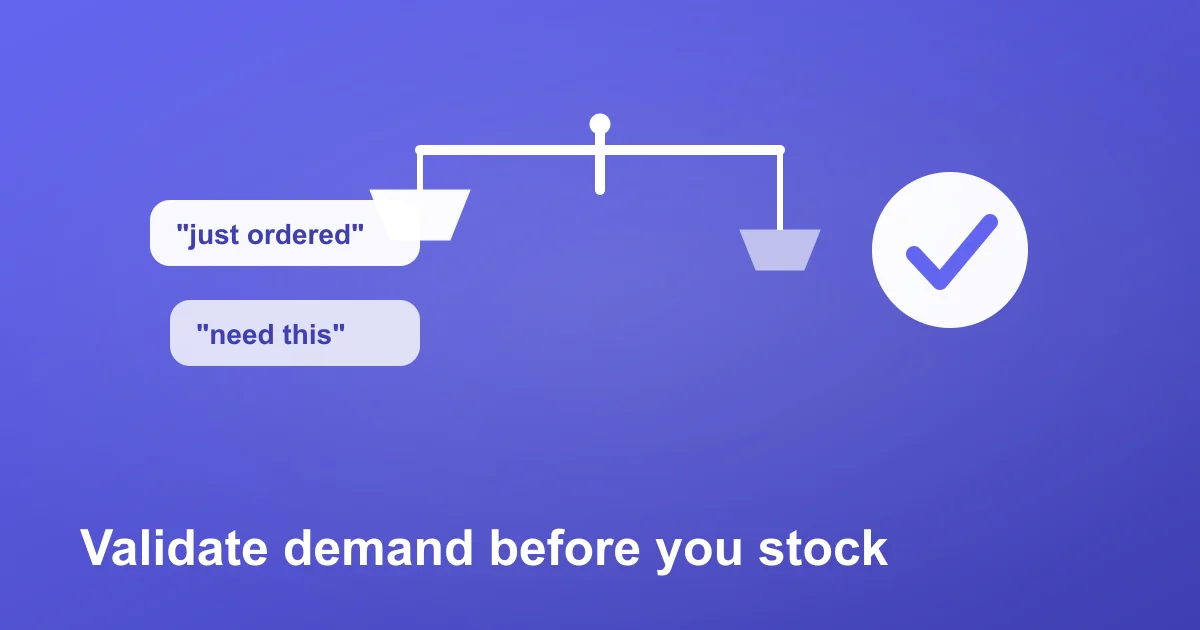
- Buying intent — "where can I buy this", "need this", "just ordered", "take my money".
- Objections — "too expensive", "looks cheap", "does it actually work", "scam?", "shipping takes forever".
- Questions — genuine "how does it…", "is it safe for…", "does it come in…".
The intent-to-objection ratio is your validation signal. A comment section that's mostly "I need this" with a few price gripes is a green light. One that's a wall of "looks like a scam" and "way overpriced" is the market warning you off — and it just saved you an inventory order. With a few thousand comments, AI analysis does this bucketing automatically; for smaller sets, a sort and a highlighter does the job.
Step 4: Turn objections into your launch checklist
This is the step that pays for itself. Every recurring objection is a conversion blocker — and because it surfaced before you launched, you get to fix it in advance instead of discovering it from unsold stock:
- "Too expensive" → reconsider price point, or build a bundle that reframes the value.
- "Looks cheap / does it work" → lead your listing and ads with demos, reviews, and guarantees.
- "Does it come in…" / "wish it had…" → stock the variant the market is asking for and the competition isn't offering.
- "Shipping takes forever" → a fulfillment edge becomes your headline.
Researching competitors' comment sections this way is the single best free product research available — they ran the test, and their unhappy customers are telling you exactly how to win the ones they lost.
Step 5: Verify the audience is yours to sell to
Demand only counts if you can capture it. Run audience analysis on the most-commented videos to estimate the age, gender, and country of the people showing intent. A product validated by a flood of comments from a region you can't ship to, or a demographic that can't check out, is not validated for you. This converts "the market wants this" into "my reachable market wants this."
Step 6: Decide with a scorecard, not a gut call
Pull it together into a simple go / no-go scorecard for each candidate:
- Intent density — buying-intent comments per thousand views.
- Objection profile — are the blockers fixable by you, or fundamental to the product?
- Audience fit — does the demand come from a market you can serve?
- Saturation — are the buying-intent comments going unanswered, or already full of competitor links?
A product that scores well across all four is validated. Now your inventory order is backed by evidence, and the money you would have lost on bad bets stays in the business.
The bottom line
The difference between sellers who scale and sellers who bleed cash on dead stock is rarely product discovery — it's the discipline to validate before they buy. TikTok comment sections hand you demand, objections, and audience data for free, if you read them at scale instead of skimming the top few. Export the comments on the product you're considering and let the market validate it before your wallet does.