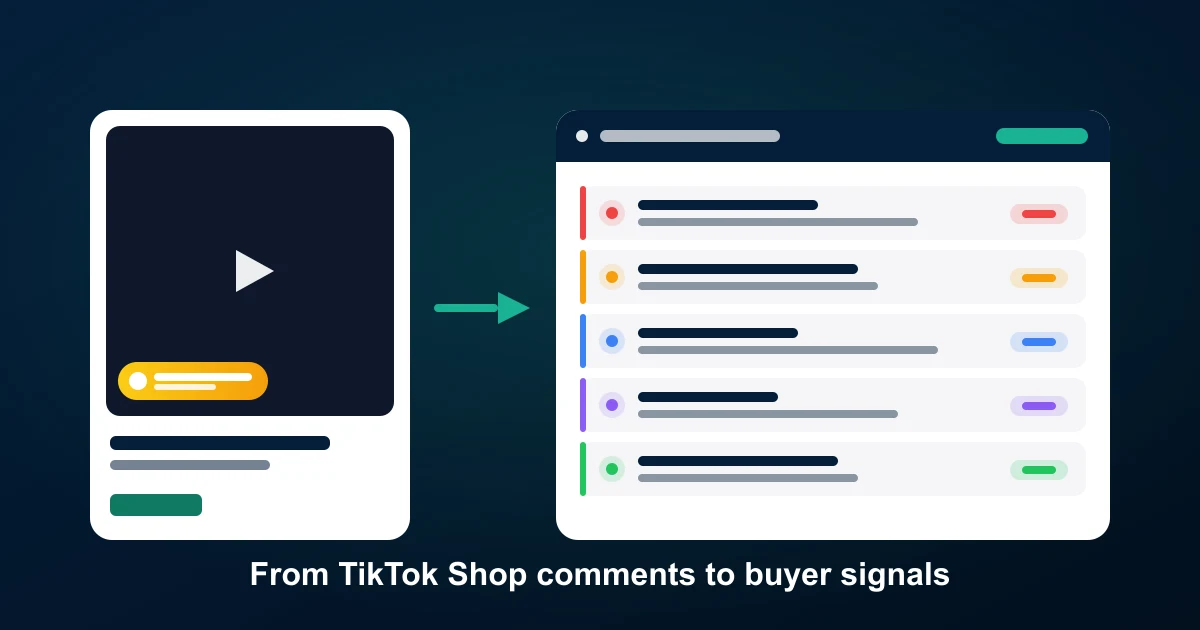
TikTok Shop comments are the single most underused dataset in social commerce. Every time a creator drops a video tagged with a product, the comment thread fills with the exact questions a brand pays a research firm thousands to surface: who wants to buy, who hesitated, what stopped them, which size, which scent, which color, what the price ceiling is, what comparison product they're weighing against.
Most brands ignore it. They watch the GMV number tick in the seller dashboard and the comment thread scrolls past unread. That's leaving the product team and the next ad brief blind to the highest-signal source of customer voice on the internet.
This guide covers how to extract TikTok Shop comments at scale, the buyer-signal categories worth classifying, and the workflows brands use to feed comment data back into product, paid social, and customer support.
What makes TikTok Shop comments different
A comment under a regular TikTok video is usually reaction — funny, agree, disagree, off-topic. A comment under a TikTok Shop video is far more often transactional. The viewer has already seen a yellow product tag, a price, and a "Shop now" overlay. The decision being made in the comment is "do I buy this?", not "do I like this?".
That changes the comment mix. The signals you find in a TikTok Shop thread, in rough order of volume:
- Pre-purchase questions — size, fit, ingredients, shipping time, return policy, whether it works for X skin type, whether it comes in Y color.
- Hesitation signals — "looks good but ___", "I want this but my budget right now", "is this dropshipped from ___".
- Just-bought confirmations — "running to my cart", "added", "ordered, will report back".
- Post-purchase reviews — "got mine last week, here's what I think". These build up as the video ages and turn into the most valuable data in the thread.
- Comparison mentions — references to competing products, often with a verdict.
- Objections and complaints — quality concerns, delivery issues, expectations vs. reality.
A typical TikTok Shop comment thread on a video with 500K views will contain 200-800 comments, of which roughly 60-75% fall into one of the categories above. That's a much higher signal-to-noise ratio than organic content. If you tag and analyze them properly, every video becomes a free focus group.
The buyer-signal taxonomy
The single biggest mistake brands make is treating TikTok Shop comments as a sentiment problem. Sentiment ("positive / negative / neutral") is a starting point but it answers the wrong question. The useful classification is by buyer stage and action signal.
Here's the taxonomy we use when classifying TikTok Shop comments for brand clients:
| Category | What it sounds like | What to do with it |
|---|---|---|
| Hot intent | "buying this now", "added to cart", "where is the link", "running" | Count as a leading indicator of attributable lift. Feed volume of hot-intent comments per ad spend dollar back to media buying. |
| Warm intent | "need this", "want this", "tempted", "this is genius" | Treat as a retargeting pool signal. Hot creators with high warm-intent volume are scale-up candidates. |
| Pre-purchase question | "does it come in", "is it safe for", "how long does shipping take" | Feed to product / ops / support. Top 10 most-asked questions become the next PDP FAQ section. |
| Hesitation | "looks great but $X is steep", "I'd buy if it came in", "wish it was at Sephora" | Pricing, distribution, and product-line-extension signal. Aggregated hesitations are roadmap input. |
| Comparison | "how does this compare to Brand X", "I already use Y, why switch" | Competitive intelligence. The named competitor and the framing tell you the substitution risk. |
| Post-purchase positive | "got mine, obsessed", "5 stars", "ordered 3 more" | UGC mining. Pull the comment + the commenter's profile and reach out for re-share rights. |
| Post-purchase negative | "got mine, disappointed", "broke after 2 days", "shipping was 4 weeks" | Quality / ops alert. Cluster by reason; if a defect mode shows up >3 times, escalate to product. |
| Trust concern | "is this real", "looks like AliExpress", "scam alert" | Authenticity / brand-perception problem. If >5% of comments hit this, the creative is reading as drop-shipped. |
Eight categories, not three. Sentiment can still ride on top as a secondary tag, but the buyer-stage taxonomy is what makes the data actionable.
The workflow: from URL to insight
Here's the workflow a brand or agency operations lead can run in an afternoon, repeatable weekly.
Step 1 — Collect URLs
Pull the TikTok URLs of every video tagged to your product (or your competitor's). Sources:
- TikTok Shop seller backend → affiliate / creator orders → click through to each video.
- TikTok search for your product name, hashtag, and SKU code.
- For competitor research: search the competitor's brand name and product line; sort by most recent and most viewed.
Aim for 20-50 videos per analysis pass. Fewer than 20 and you risk over-indexing on a single creator's audience. More than 50 starts hitting diminishing returns within a single product cycle.
Step 2 — Bulk export the comments
Drop the URLs into a bulk export tool. ZocialComment's export page exports one URL per job and gives you CSV with comment text, author, like count, reply threading, and timestamp. For TikTok Shop analysis, include replies — the post-purchase reviews almost always sit in the reply threads under the most-liked top-level comment.
Step 3 — Classify against the buyer-signal taxonomy
You can do this three ways:
- Manual coding: a researcher reads each comment and assigns a category. Accurate, but expensive — about 4-6 hours per 1,000 comments at agency rates.
- AI classification: run the comments through a language model with a prompt that defines the eight categories and asks for a label + confidence. Around 30 seconds per 1,000 comments at a tiny fraction of the cost. ZocialComment's analysis layer includes intent and purchase-signal classification out of the box.
- Keyword rules + manual sampling: regex match for cart/buy/order/where-is-link etc., then sample 5% for QA. Cheap, fast, and good enough for monitoring once the taxonomy is stable.
For most brand teams, AI classification with a 10% human spot-check is the right cost-quality balance.
Step 4 — Aggregate and surface
The classified data should produce, at minimum, three views:
- Funnel view — count of hot-intent / warm-intent / question / hesitation / comparison comments, per video and aggregated. The shape of the funnel by creator tells you which creators drive purchase vs. awareness.
- Question backlog — top 25 most-asked pre-purchase questions, sorted by frequency. This feeds PDP FAQ, ad copy hooks, and the customer support knowledge base.
- Hesitation breakdown — the specific reasons buyers paused. Cluster these and you have a product-and-pricing roadmap input grounded in real customer voice.
Step 5 — Loop it back into the next decision
Comment analysis that doesn't feed a downstream decision is research theatre. Common loops that work:
- Paid creative — top question becomes the hook of the next ad. Top hesitation becomes the objection-handler frame.
- PDP copy — top 10 questions are pre-answered above the fold.
- Creator roster — creators with highest hot-intent-per-1k-views become preferred for the next launch.
- Product roadmap — hesitation clusters around missing variants ("wish it came in") feed line-extension prioritization.
- Ops — defect-mode clusters in post-purchase negatives trigger QA review.
Three brand use cases that pay back the analysis
1. Pre-launch product research without a focus group
Before launching a new SKU, find 30-50 TikTok Shop videos featuring the closest analog product — same category, similar price point, similar form factor. Export and classify the comments. The hesitation and comparison categories will tell you the price ceiling, the most-wanted variant, the dominant substitute, and the trust concerns the category carries. Total cost: one pass and an hour of an analyst's time. The focus-group equivalent runs $25K and three weeks.
2. Live campaign performance, not just GMV
During a campaign, run the comment analysis weekly, by creator. Compare hot-intent volume per 1,000 views across creators. Cross-reference against the seller backend's GMV-by-creator numbers. You'll quickly find creators whose comment intent doesn't match their GMV — usually because the audience is enthusiastic but not in the buying demo, or because the checkout funnel is leaking. Both are actionable; neither shows up in the dashboard alone.
3. Competitive teardown
Pick three direct competitors. Export 30 of their best-performing TikTok Shop videos each. Classify. The output is a competitor-by-competitor breakdown of: what their customers love, what their customers complain about, what they're missing that buyers explicitly ask for. The hesitation and post-purchase-negative categories are gold here — they're the gaps a smart product team can drive a wedge into.
Tooling and pricing reality check
The reason most brands don't already do this is the tooling fragmentation: comment extraction, classification, deduplication, threading, and surfacing usually live in different tools. Stitched together manually with spreadsheets and a researcher, the analysis takes too long to be weekly.
The shortest path is a tool that does extraction and classification in one pass. ZocialComment's analysis exports comments and runs sentiment, intent, audience, and topic classification in a single workflow — included with any pass, one URL per export. A typical TikTok Shop research pass — 30 videos, 500 comments each — sits comfortably inside one 3-Day Pro Pass, which covers unlimited posts of up to 100,000 comments each.
Brands and agencies that need this run continuously — daily monitoring across competitor URLs, scheduled exports into a warehouse, alerting on sentiment swings or defect clusters — usually outgrow a self-serve tool by the third month. That's the threshold where a managed comment-intelligence service starts to pay back: continuous scraping, classification, dashboarding, and a direct line to the team running it, without the in-house data engineer.
What to measure to know it's working
If the comment-analysis workflow is doing its job, you should see two changes within 90 days:
- The ad CTR on creative driven by comment-mined hooks beats the previous best creative — usually by 15-40% in our experience. Hooks written from real audience questions outperform hooks written from a marketer's intuition every time.
- The pre-purchase question volume in the comment thread itself goes down — because the PDP and the creative are pre-answering them. This is the long-term flywheel: comment analysis improves the creative, the better creative shifts the comment thread from questions to purchases, which lifts conversion.
Frequently asked questions
Are TikTok Shop comments different from regular TikTok video comments?
Yes — the mix is heavily skewed toward transactional signals: pre-purchase questions, hesitation, just-bought confirmations, post-purchase reviews. Compared to organic video comments, TikTok Shop threads have a much higher density of buyer-stage signal and lower noise.
Can I see comments on a TikTok Shop product if I'm not the seller?
Yes — comments on TikTok videos are public regardless of whether you're the seller of the product tagged in the video. That's what makes comment analysis viable for competitive research as well as your own products.
How many comments do I need to draw conclusions from a TikTok Shop comment analysis?
For a single-video deep read, 100+ comments. For category-level conclusions about a product line, aim for 5,000+ comments across 20-50 videos. Below those thresholds you're working with anecdote, not data.
How do I tell a real "buying intent" comment from sarcasm or hyperbole?
This is exactly what AI classification with a labeled training set handles better than keyword rules. A simple "want this" keyword match will pick up sarcasm ("yeah I want this 🙄") as positive intent. A language model in the classification step picks up the sarcasm and downgrades the comment to neutral or negative — which is why the AI-classification path is usually worth the slightly higher cost than pure regex matching.
Is this legal — am I allowed to export and analyze comments?
Comments posted publicly on TikTok are accessible without authentication. Most jurisdictions treat publicly posted social media content as fair use for analytical and research purposes when no personally identifiable inferences are sold or republished against the original poster. Always check TikTok's current terms and your local jurisdiction (GDPR adds constraints in the EU). For UGC re-share — using a commenter's words or profile in your ads — you need their permission.
Start small, then run it on schedule
The right way to start: pick one product, find 20-30 TikTok Shop videos tagged to it, export and classify the comments, write down the top 5 questions and top 5 hesitations. Use those to brief the next ad and the next PDP edit. Track the conversion rate before and after.
Once that single pass proves out, the case for running it weekly across your full SKU lineup writes itself. Bulk export and analyze are the do-it-yourself entry; managed monitoring is the upgrade when the workflow becomes a permanent input to the brand team.
Related reading: TikTok Shop's new seller features.