Brand mentions inside TikTok comments are where the truth about your brand lives. Customers, prospects, and detractors talk about your product candidly in reply threads that almost no one on your team is reading. Some of those comments are about to go viral. Some are about to torch a launch. Most are unfiltered customer voice the rest of your research stack would pay for.
Yet most brand teams still treat TikTok monitoring as a tab someone occasionally checks. This guide is the alternative — a complete framework for monitoring TikTok brand mentions in comments, the categories that matter, the tools that make it scalable, and what to actually do with the signal when you find it.
What "brand mentions in comments" actually means
Most TikTok brand monitoring tools track video captions and on-screen text. That misses 70-90% of the conversation. The bulk of brand mentions on TikTok happen in:
- Comments on your own videos — direct feedback, support questions, complaints, praise.
- Comments on competitor videos — customers comparing you against competitors, often unprompted.
- Comments on category or trend videos — "what's the best X?" videos where commenters recommend or warn against brands.
- Comments on creator content — both paid (your campaigns) and unpaid (organic mentions by creators outside your network).
- Reply threads under viral comments — sub-conversations that don't surface in any caption search.
If you're only watching captions, you're missing the layer of the conversation where buying decisions actually get debated.
The four signal types worth tracking
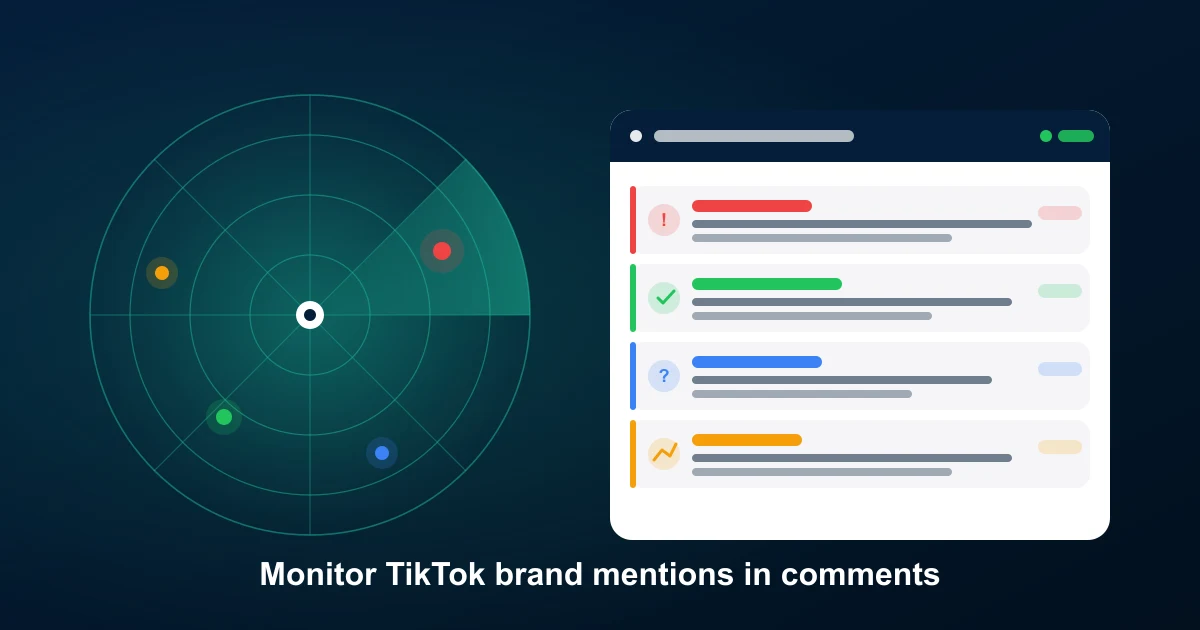
Not every brand mention is created equal. Tag them by type so the team responds to the right ones in the right way.
| Signal type | What it sounds like | Response |
|---|---|---|
| Crisis | "avoid this brand", "they sent me a broken one", "scam", "refund nightmare" | Same-day. Reach out, resolve publicly if possible, log the root cause. |
| Advocacy | "obsessed with this brand", "5 stars", "ordered again", "my favorite" | Same-week. Reach out for UGC re-share rights or community ambassador program. |
| Question | "is this brand legit", "does it ship to UK", "how does it compare to X" | Same-day if it's a fact question; if it's a comparison, response is creative input, not a reply. |
| Trend | Sudden spike in brand mention volume — positive or negative | Trace to the video that drove the spike. If positive, amplify. If negative, get ahead of it before the mainstream cycle picks it up. |
Most brand teams under-respond to questions and over-respond to advocacy. The teams that win the brand-on-TikTok game are the ones that respond fast to questions (because the asker is a hot lead) and aggressively to crises (because TikTok crises compound on a 4-8 hour clock).
What to monitor — the watchlist
A complete TikTok brand-mention watchlist has five layers. Most brands run the first three; the last two are where category leaders pull ahead.
Layer 1 — Your own content
Every video on your owned account and any creator account where you've sponsored content. Pull comments on a recurring schedule (daily for active campaigns, weekly for evergreen content). Classify by the four signal types above.
Layer 2 — Direct brand mentions
Search TikTok for your brand name, your product names, your branded hashtag, and common misspellings. Pull the videos. Pull the comments on those videos. This catches both creator-driven mentions and the "I just bought X from Y" videos that don't tag your account.
Layer 3 — Competitor content
Pull comments on competitor videos — their owned content and the creator content they sponsor. A meaningful share of competitor comment threads include unprompted mentions of your brand ("I tried X, switched to Y, this is way better"). These are some of the highest-trust mentions on the platform because they're not solicited.
Layer 4 — Category and trend content
Identify the "what's the best ___" / "rating viral ___" / "trying ___ for 30 days" videos in your category. These videos have comment threads that turn into category-level discussions where five or six brands get named, compared, and ranked. Your brand will be mentioned in these whether you watch or not.
Layer 5 — Reply threads under viral comments
This is the layer most monitoring tools miss entirely. A top-level comment with 12,000 likes on a category video will have 200+ replies, half of which are brand mentions. None of those reply-level mentions show up in a video-caption search. The only way to surface them is to export comments with reply threading included.
Setting up the pipeline
A working TikTok brand-mention pipeline has five stages. You can run it manually for a small brand with a few dozen mentions a week, or automated for a category leader with hundreds of mentions a day.
Stage 1 — Discovery
The watchlist above is the discovery stage. Translate each layer into a list of TikTok URLs and search queries you'll re-run on a schedule. For most brands, this is 30-60 URLs per category layer, refreshed weekly.
Stage 2 — Extraction
Pull the comments on each URL. Include replies. Include timestamps and author info. For brand-mention monitoring, you specifically want the full reply tree because that's where the unprompted mentions live. ZocialComment's exporter handles one URL per export with full reply threading in CSV or JSON.
Stage 3 — Filtering
Filter the comment stream to just the comments that mention your brand. This sounds simple but isn't — common gotchas:
- Misspellings and abbreviations — your filter needs to catch these too. Build a regex with the variants.
- Substring matches against unrelated words — if your brand name is a common English word, you'll need negative filters.
- Languages — TikTok comments are global. If you sell in non-English markets, filter for transliterations too.
This is where keyword filters break down for large brands. A language-model classifier with a prompt that defines "mentions our brand" handles the variations cleanly.
Stage 4 — Classification
For each brand-mention comment, tag the four signal types above (crisis / advocacy / question / trend). Sentiment is a useful secondary tag. ZocialComment's analysis handles sentiment and intent classification out of the box; a custom prompt against the same comment dataset gives you the brand-specific four-signal tags.
Stage 5 — Routing
Each signal type needs to land in front of the right team within the right time window.
- Crisis → community manager Slack channel, same-hour ping.
- Advocacy → community / UGC team, weekly digest.
- Question → community manager for support questions; creative team for comparison questions (input for next ad).
- Trend → brand lead, daily dashboard with mention-volume sparkline.
Routing is where most monitoring programs fall over. Pulling the data is the easy part; making sure the right person sees the right comment within the right window is the hard part. Build the routing into the workflow from day one, or the monitoring becomes a graveyard.
Manual vs. automated: which one and when
Manual monitoring — a community manager running searches and exports a couple of times a week — works fine up to a point. The point is roughly the moment your brand starts hitting 100+ mentions a week across the watchlist layers. Above that, manual processing burns hours that the team should be spending on response and creative, not on data plumbing.
| Brand size | Typical mention volume | Approach | Time cost |
|---|---|---|---|
| Early stage | <30 mentions/week | Manual search + export weekly | ~2 hours/week |
| Growth stage | 30-150 mentions/week | Tool-assisted: bulk export + AI classification on schedule | ~3-5 hours/week |
| Category leader | 150+ mentions/week | Automated pipeline + dashboarding + alerting | Setup once, then ~30 min/day to review |
| Crisis-sensitive | Any volume | Real-time alerting on crisis-signal keywords regardless of volume | Setup once, plus response time on alerts |
The transition point — from manual to tool-assisted — is also where the ROI gets obvious. A community manager spending 8 hours/week on data extraction costs the same as a tool that does the extraction in minutes; the difference is the manager now spends those 8 hours actually responding, which is where the brand value compounds.
Crisis response: the 4-hour window
TikTok crises move faster than any other platform's. A negative video that picks up traction in the morning is on the For You page by lunch and on Twitter by evening. The window to get ahead of it is roughly four hours, and the only way to hit that window consistently is automated keyword alerting on the crisis-signal language.
The crisis-keyword list to monitor (adapt to your brand and category):
- "avoid [brand]", "don't buy [brand]", "[brand] scam", "[brand] fake"
- "refund nightmare", "they won't refund", "stuck with [brand]"
- "broke after", "stopped working", "fell apart" + brand name in same comment
- "customer service is" + brand name (almost always negative)
- Any brand mention with high reply velocity in the first hour (often a leading indicator)
The alerting layer should ping whoever owns brand response within minutes of the first match. The first response — usually a public reply with an offer to DM and resolve — defuses the majority of TikTok crisis spirals before they hit the algorithm's amplification threshold.
Three operating models that work
Model 1 — In-house community team owns it
Works for brands with a dedicated community manager and a clear escalation chain. The community manager runs the weekly watchlist refresh, classifies the comments, routes the signals, owns first response on crises and questions. A self-serve comment-export tool plus a shared spreadsheet or Airtable for tracking is enough.
Model 2 — Agency-managed monitoring
Works for mid-size brands without a dedicated community team or for category leaders that want continuous coverage across many SKUs. The agency runs the pipeline; the brand team gets a daily dashboard and crisis alerts. Cost is meaningfully higher than self-serve, but the per-decision quality of the data is much higher too because the agency has built the routing once and re-uses it across clients.
Model 3 — Managed comment-intelligence as a service
A middle path: the brand keeps the community team in-house for response, but outsources the data pipeline to a managed comment-intelligence service. The service runs the recurring scrapes, classification, and alerting; the brand team gets the cleaned signal in their tools. We run this model for several brand clients — it sits between Model 1 (cheap, manual) and Model 2 (full agency overhead) and works well for brands that want continuous monitoring without rebuilding the infrastructure or paying for response time they don't need. Details on the managed service.
Metrics to report up the chain
If TikTok brand monitoring is going to survive the next budget review, leadership needs to see the metrics that prove it's working. Three are enough:
- Mention volume, by signal type, week over week. Total mentions trending up is usually good; mentions by signal type tell you whether the upward trend is driven by advocacy (great), questions (great if you're answering them), or crises (act now).
- Median time-to-response on crisis and question signals. Track this. Under 1 hour for crisis, under 4 hours for questions, is the benchmark we use. If the number is creeping up, the routing is broken.
- Conversion or sentiment lift attributable to monitoring interventions. When a comparison-question signal turns into ad copy that beats the previous creative, log it. When a crisis response defuses a thread before it goes viral, log it. The compounding case for monitoring is built from these specific wins.
Frequently asked questions
What's the difference between TikTok brand monitoring and TikTok social listening?
Social listening tools (Brandwatch, Sprout, Talkwalker) typically monitor public posts and captions. TikTok brand-mention monitoring as described here specifically targets the comment layer — including reply threads — which is where the higher-signal customer voice lives. The two are complementary: post-level listening tells you what's published; comment-level monitoring tells you what people are actually saying about it.
How often should we refresh the monitoring data?
Daily for active campaigns and crisis-sensitive brands. Weekly for evergreen content and competitor watch. Real-time keyword alerting for crisis-signal language regardless of refresh cadence.
Can we monitor TikTok comments without violating TikTok's terms of service?
Comments on public TikTok videos are publicly accessible. The relevant constraints are: don't impersonate users, don't republish PII against the original commenter, don't use the data in ways that violate GDPR or other regional privacy laws. Standard analytical and aggregate-reporting use is broadly accepted; check current terms and your local jurisdiction.
What's the right tool for a brand just starting TikTok monitoring?
Start with a self-serve comment-export tool plus a shared spreadsheet. ZocialComment's exporter handles one URL per export and includes reply threading. Once volume exceeds a few hundred comments per week and the spreadsheet becomes the bottleneck, layer AI classification on top via the analysis page. When even that becomes too much to maintain, upgrade to a managed pipeline.
How do we monitor brand mentions on creator content we haven't sponsored?
Search TikTok for your brand name and product names. Pull the videos that come back. Pull the comments on those videos with bulk export. This catches both the creator-driven mentions (where the creator names your brand) and the audience-driven mentions (where commenters bring you up in someone else's video).
Where to start this week
Pick one weekday afternoon. Build the watchlist: your owned content, three competitor accounts, ten category videos. Run a single bulk export across all of them. Read the brand-mention comments. Write down the crises you didn't know about, the questions no one answered, the advocacy you could have re-shared, and the comparisons you should have addressed in your last ad.
That single pass usually surfaces enough findings to justify the ongoing program. Bulk export and classification get you started; managed brand monitoring takes it off your team's plate when the program graduates from "afternoon project" to "permanent input to the brand."